hubbuy Storage Cart QC Photo Checks
hubbuy Storage Cart QC Photo Checks
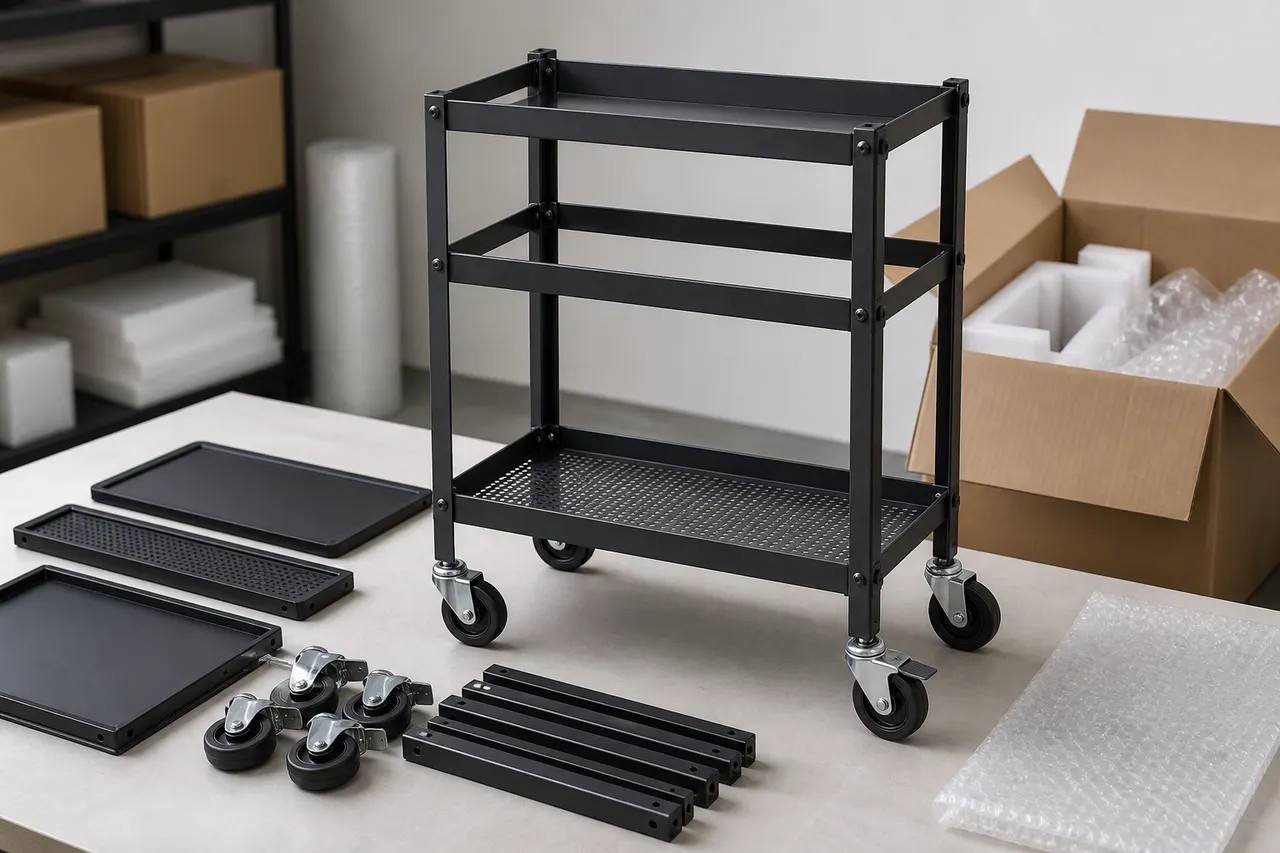
Caption: Key points for checking hubbuy storage cart QC photos
When buying a storage cart through the hubbuy proxy, the purpose of QC photos is not to judge whether it "looks good", but to judge whether this bulky, lightly structured, easily damaged household item is still safe to ship, whether additional photos are needed, or whether you should switch to a different candidate. The common risks for storage carts are concentrated in three areas: wheels, shelves, and corners. If these three areas are unclear, subsequent consolidation, international shipping, and receiving and assembling will be more passive 🛒
This article applies to users who have already received QC photos in the hubbuy warehouse and are preparing to decide whether to ship. It does not apply to judging seller inventory, current prices, real-time platform route costs, or destination country taxes; this information needs to be based on the hubbuy page, seller page, and logistics quotes before ordering and shipping, and recorded according to the actual verification date.
First determine the usage risks this QC should address
A storage cart is not a high-precision product, but it has several very real usage risks: hard to push, unstable, warped shelves, sharp corners, and deformation after shipping. QC photos should answer these questions first, not just show whether the outer packaging is intact.
Before checking, it is recommended to divide goals into three categories:
Whether it can be assembled: wheels, handle, shelves, screw holes are all present.
Whether it can stand steadily: the four corners, wheel assembly, and shelf frame are not obviously skewed.
Whether it is worth continuing to ship: the flaw is a minor appearance issue, or will affect assembly and load-bearing.
If the QC photos only show the front of the packaging and a distant view, it is usually not enough to make a decision. The risks of storage carts mostly occur at the bottom, holes, corners, and connections, which are easily missed in distant views.
What hubbuy table candidates and QC photos can prove
In a proxy process like hubbuy, users usually cross-check between the product link, specification options, seller images, and warehouse QC photos. QC photos can prove "the appearance and component condition of the item currently received by the warehouse", but cannot automatically prove material strength, long-term durability, official promises, or that all seller page parameters are true.
Item to check | What QC photos can prove | What QC photos usually cannot prove |
|---|---|---|
Wheel assembly | Whether wheels are missing, whether wheel brackets are obviously broken, whether brake parts are visible | Long-term rolling smoothness, stability under load |
Shelves | Whether bent, cracked, missing parts, frame deformation | Actual maximum load, sagging after long-term heavy items |
Corners | Whether there are dents, sharp burrs, shipping pressure marks | Whether the material is wear-resistant, whether paint will continue to chip |
Whether screws, rods, clips are visible | Whether every hole matches perfectly, unless detailed photos are taken |
A safer approach is to look at the product page specifications, order options, and QC photos together: whether the color is consistent, whether the number of layers is consistent, whether the number of wheels is consistent, whether a handle or hooks are included. If the product page says multi-layer, but the QC photo only shows a two-layer structure, you need to first ask whether it is due to angle obstruction, folded packaging, or wrong specification sent.
Wheel assembly check: swivel wheels, brake position, and mounting holes
The wheel assembly is the most easily overlooked part of a storage cart, and also the part that most easily affects actual use. At a minimum, the QC photos should show the number of bottom wheels, wheel bracket condition, and mounting area.
First check whether the wheels are all present. Common storage carts usually have one wheel per bottom corner. If the photo only shows two wheels, you cannot directly conclude that the other two definitely exist. You can ask hubbuy to take additional photos of the bottom panorama, with all four corners in frame at once.
Next, check whether the swivel wheel brackets are skewed. If the wheel bracket is obviously tilted even without load, you may experience slipping, stiff steering, or overall wobbling after receiving. If the wheels are covered by packaging bags in the photo, additional clear photos should be taken.
The brake position also needs to be looked at separately. Some storage carts only have two wheels with brakes, and some have no brakes. QC does not need to force all wheels to have brakes, but you should confirm that the received configuration matches the order specifications. If the product page or option promises brakes, and the QC photo does not show brake levers at all, you should apply for additional photos or have the warehouse check the accessories.
Mounting holes are another key point 🔍 If the area around the holes is cracked, deformed, or blocked by paint, it may cause unstable assembly. It is hard to see the holes clearly in distant views, especially for white, transparent, or light-colored metal carts, so it is best to take a close-up of a bottom corner.
Shelf check: flatness, frame, load-bearing points, and gaps
The shelves determine whether this cart can hold items steadily. In QC photos, look at three things: whether the board is flat, whether the frame is straight, and whether there are abnormal gaps at the connections.
Slight reflection on the board surface does not mean deformation, but if the same shelf edge is wavy, corners are lifted, or the center is obviously sagging, be cautious. Plastic shelves may be bent during shipping, while metal mesh baskets or metal shelves should be checked for weld points, frame, and paint chipping.
For the frame check, see whether the four edges form a regular rectangle. If the front looks higher on one side and lower on the other, it could be the camera angle or structural deformation. When unsure, ask the warehouse to take additional photos from directly above or directly in front, rather than drawing conclusions from angled shots.
Load-bearing points are mainly at the upright post connections. If the positions where each shelf connects to the uprights, clips, or screws are cracked, the risk is higher than ordinary surface scratches. Because after international shipping, the user still has to assemble or continue using it, and once the connection points are damaged, subsequent after-sales will be more troublesome.
Also pay attention to whether the gaps between shelves are consistent. A particularly large single gap may indicate that a clip is not fully installed, a shelf is deformed, or accessories are misaligned. During the QC stage, the warehouse is not necessarily required to fully assemble the item, but key accessories must be visible.
Corner and handle check: burrs, deformation, and impact marks
Corner issues fall into two categories: one is just appearance flaws, and the other affects safety and assembly. Minor scratches, a little paint chipping, and packaging imprints usually should be judged based on price, intended use, and return/exchange costs; but sharp burrs, breaks, obvious dents, and cracks at connections are not recommended to accept easily.
The handle position especially needs to be seen clearly. On many storage carts, the handle is both the force point for moving the cart and part of the overall structure. If the handle tube is bent, the interface is deformed, or the screw hole is cracked, even if barely installed, it may wobble when pushed.
For plastic models, pay special attention to whitening marks. White stress marks on plastic corners may just be surface pressure marks, or they may be stress points about to crack. For metal models, check whether the base material is exposed after paint chips, especially if used in humid environments, which may be more prone to rust later.
If the QC photo shows the packaging box severely crushed, it does not mean the inside is definitely damaged, but it increases the probability of internal deformation. In this case, it is best not to only look at the outer box; at least additional photos of the bare item's corners and shelves close-up are needed 📦
Evidence gap checklist: which angles need additional photos
Additional photos are not about taking as many as possible, but about filling in angles that will affect the decision. When requesting additional photos, be specific and avoid just saying "make it clearer". Warehouse staff can more easily execute clear requests.
Priority additional photo angles:
Bottom four corners in one frame: confirm all four wheel assemblies are present and not skewed.
Close-up of a single wheel: confirm wheel bracket, brake lever, and mounting hole are not damaged.
Shelf directly from above: judge whether the board is warped and the frame deformed.
Close-up of upright post connections: confirm clips, holes, and screw areas are not cracked.
Handle interface photo: confirm handle is not bent and interface not crushed.
Close-up of obvious impact marks: judge whether it is just packaging marks or structural damage.
You can write the request for additional photos like this:
Please take additional photos of the storage cart bottom with all four wheels in one frame, a close-up of any wheel with brake, a directly overhead photo of each shelf, and a close-up of the handle connection. If there are cracks, dents, or missing parts, please take separate clear photos.
This request is more effective than "please check quality" because it specifies the positions and abnormal conditions the warehouse needs to photograph.
Pre-receipt decision: accept, switch candidate, or postpone order
After reviewing QC, you can handle it in three risk levels.
Level 1 is acceptable: wheel assemblies present, shelves have no obvious deformation, corners have only minor scratches that won't affect assembly, and accessories match order specs. This situation is suitable for continuing to calculate international shipping costs, whether to consolidate, and destination country import requirements.
Level 2 is needing additional photos before deciding: wheels blocked, bottom not photographed, shelf angle not straight, handle interface unclear, packaging clearly crushed but no detailed photos of bare item. These issues should not be shipped directly, but also not abandoned immediately; gather more evidence first.
Level 3 is recommend switching candidate or postponing: wheel bracket broken, shelf cracked, key holes deformed, handle bent, accessories clearly missing, or seller specs inconsistent with actual QC photos. Storage carts are usually bulky, and cross-border return/exchange and after-sales costs may be higher than the price difference of a single item; before continuing to ship, recalculate whether it is worth it.
Also be cautious with consolidation 🚚 Storage carts may take up volume, and when consolidated with clothes and small accessories, it may indeed reduce duplicate first weight or handling costs; but if the cart corners are hard, it may also crush soft-packed goods. If it has deformation risk, it is recommended to have the warehouse reinforce protection or ship separately from crushable goods.
The final judgment can be summarized in one sentence: QC photos are not for finding a perfect product, but for confirming whether the risks are acceptable before payment and shipping. For storage carts, as long as the three areas of wheel assemblies, shelves, and corners have complete evidence, users can more clearly decide to accept, request additional photos, switch candidates, or postpone the order.
First-time users of the agent platform should also confirm whether the platform can retain order records, QC photos, additional photo communication, and logistics information, and avoid disclosing order numbers, addresses, phone numbers, or payment information to unrelated people. Screenshots involving personal information should be masked before being used for communication or archiving 🔐
Agent Platform Shopping FAQ
1. What are the key things to know for first-time shoppers on hub-buy.com?
When new users first access hub-buy.com's Taobao proxy service via spreadsheet, they usually receive a shipping discount package specifically for newcomers. Additionally, it is recommended that you read the step-by-step shopping tutorial for beginners.
Browse our latest products and find your next favorite item.