Hubbuy Small-Space Storage Cart Search
Hubbuy Small-Space Storage Cart Search
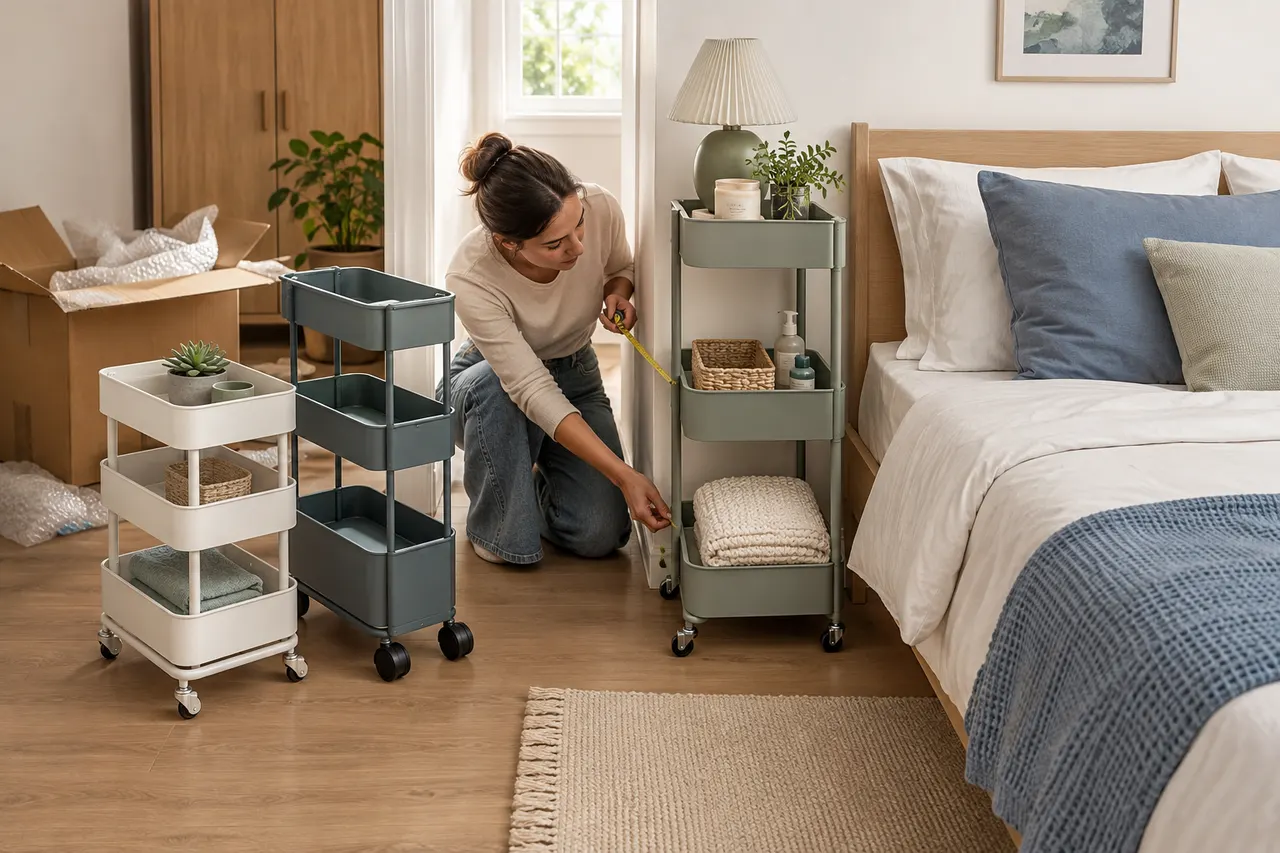
For small homes, the real challenge in buying a bedside storage cart is not finding a style you like, but confirming that it can fit between the bed and the wall, nightstand, or wardrobe, and move properly when loaded. Relying only on "multi-tier," "narrow," or product images can easily lead to buying a cart that barely fits the width but gets stuck due to protruding handles or wheels.
This guide will help you search for candidate products on Hubbuy and rank them based on size, number of tiers, wheel assembly, and movement clearance. After reading, you should be able to create a reviewable candidate list rather than relying on promotional terms like "suitable for small spaces" in product titles.
This guide is not applicable to wall-mounted shelves or furniture choices for environments where children climb, and it cannot replace the seller's explicit statements about load capacity, materials, or package contents. Product prices, inventory, dimensions, shipping costs, route restrictions, and after-sales conditions may change. This guide does not provide unverified real-time data; before ordering, always refer to the actual product page, order page, and customer service responses dated September 3, 2026 or later.
First measure available width, height, and passage distance beside the bed
Do not search for products yet. Use a tape measure to measure the actual space the cart will occupy and record the results. At least four measurements are needed:
The narrowest clear width between obstacles on the bed side; do not just measure from the mattress edge to the wall.
The height of the bed surface or top of the bed frame, to determine if accessing the top tier is comfortable.
The available length in front and behind the cart, including areas occupied by the headboard, outlets, curtains, and cabinet doors.
The passage width needed for people to pass, especially considering nighttime movement and door opening.
When measuring, check both the floor and handle height areas. Baseboards may keep the cart bottom away from the wall, while windowsills, protruding bed frame edges, or chargers on outlets may limit upper space. If there are carpet seams or thresholds on the floor, record their locations, because small wheels that can cross when empty may not roll easily when loaded. 📏
Do not treat the measured clear width as the maximum product width. The cart needs clearance for assembly tolerance, wheel swivel, and hand operation space. If the passage also serves daily walking, first mark off the non-occupiable walking area, then use the remaining space to determine the candidate limit.
Clarify the items to store and the load capacity needed for each tier
Classify the items you plan to put on the cart by size and frequency of use. Writing only "miscellaneous" is not helpful; be specific, such as water cups, books, tissues, charging devices, medicine boxes, skincare products, or spare bedding.
Start by recording three things:
Measure the tallest, widest, and heaviest single item.
Record items that need to stand upright, lie flat, or be protected from tipping.
Assign tiers based on daily use, occasional use, and backup items.
Taller bottles are affected not only by the overall cart height but also by the clearance between tiers and the shelf above. Books or sets of bottled products can quickly increase the load on a single tier, so do not judge capacity by "looks like it can hold." If the product page does not clearly state the load capacity per tier or for the whole cart, note it as unknown and do not calculate or speculate.
Also consider safety boundaries for bedside use. Hot water, fragile glass items, or items that need light protection should not be placed casually just because the cart is convenient. Keep power devices and liquids on separate tiers and avoid charging cables crossing the passage.
Combine size, tier count, and structure terms when searching on Hubbuy
When searching on Hubbuy, start with terms that describe the product itself, then gradually add restrictions. Piling too many terms at once may miss products with different titles but suitable structures.
Suggested split of search terms into three groups:
Size terms: narrow, ultra-narrow, gap, bedside, small space.
Tier count terms: two-tier, three-tier, four-tier, multi-tier.
Structure terms: with wheels, push cart, shelf, storage cart, with handle, with guardrail.
In the first round, search "narrow storage cart" and observe common product names and structural expressions in the results. In the second round, combine "narrow three-tier with wheels" or "gap shelf with handle." If results are too few, remove tier count or scenario terms one by one, rather than immediately relaxing the size requirement.
The search results page only helps discover candidates and cannot replace checking product details. A title saying "ultra-narrow" does not mean its outer dimensions fit your space, and "three-tier" does not necessarily mean all three tiers can hold your target items. 🔎
It is recommended to first bookmark or record 5 to 8 structurally different candidates, then compare them together. Do not order the first product with similar dimensions, because you may later find protruding handles, non-lockable wheels, or insufficient tier clearance.
Use essential criteria to filter out candidates that are too wide, too tall, or inconvenient to move
Use non-negotiable conditions to eliminate products rather than giving all products a composite score. If a candidate violates the space limit, it should not be compensated by more tiers or a lower price.
It is more effective to filter in the following order:
Delete candidates whose listed outer width exceeds the available width limit.
Delete candidates whose total height would hit windowsills, bed frame protrusions, or switches.
Delete candidates whose length would block cabinet doors, drawers, or passage.
Temporarily set aside candidates with unclear size specifications or only illustrative images without numeric annotations.
Temporarily set aside candidates where wheel assembly, handles, or protruding connectors cannot be confirmed as included in dimensions.
"It can fit" and "it can be used normally" are different. If the cart must be fully pulled out to access lower tiers, extra operating distance is needed in front; swivel wheels may also enlarge the actual swept area when turning. For narrow gaps beside the bed, it is recommended to simulate the candidate's outline on the floor with cardboard boxes or tape, then actually walk, open cabinet doors, and reach for items. 🛒
Create a comparison table for dimensions, tier clearance, wheel assembly, and handles
For each candidate, record only information that can be directly confirmed from the product page. For missing items, write "to be confirmed" uniformly; do not fill with data from similar products.
Comparison item | What to record | Elimination or downgrade condition |
|---|---|---|
Outer dimensions | Width, length, height, and dimension drawing interpretation | Any direction exceeds on-site limit |
Tier count and clearance between tiers | Usable tiers, internal clearance per tier | Target items cannot stand upright or be retrieved |
Wheel assembly | Number of wheels, direction, whether locking is specified | Missing info and floor near bed has slope or is slippery |
Handle | Fixed, removable, or none; whether protruding | Protruding part blocks passage or hits furniture |
Shelves and guardrails | Flat, basket, holes, and edge height | Small items easily fall or target containers do not sit flat |
Load capacity info | Per-tier or whole-cart capacity and applicable conditions | Only vague claims, cannot support planned load |
Packaging and accessories | Wheels, screws, tools, and assembly instructions | Key accessories cannot be confirmed as included |
When ranking, set space fit as the top priority, followed by tier clearance and movement method, then capacity, color, and price. This avoids choosing the "largest capacity" candidate that turns out to be the most difficult to use.
Check product page dimension conventions and image evidence boundaries
Dimension information on product pages may refer to outer dimensions, shelf, basket interior, or packaging dimensions. When checking, look for dimension diagrams with measurement arrows and confirm which two boundary points the numbers correspond to.
Key checks:
Whether width includes handles, side frames, hooks, or wheel axle protrusions.
Whether height includes wheels and top guardrail.
Whether length is shelf length or maximum front-to-back dimension of the cart.
Whether the title, specification options, and dimension diagram on the same page correspond to the same tier count or model.
Whether multiple specifications share images, causing dimensions to mismatch the current option.
Images can prove that the page shows a certain structure, but cannot alone prove material strength, actual load capacity, wheel smoothness, or long-term durability. Scene images without scale bars cannot be used for precise dimension estimation. If wheel assembly, shelves, or handle shapes differ across images, treat it as a pending issue rather than arbitrarily choosing one as evidence.
If key dimensions have only a vague number, ask the seller before ordering for the maximum outer dimensions after assembly, explicitly requiring inclusion of wheels and handles. Save the questions and replies for verification upon receipt.
Check wheel assembly, shelves, connections, and packaging information
Wheels determine whether the cart can actually move in narrow spaces. Check whether the product page shows wheel quantity, installation positions, and locking structure. Merely stating "swivel wheels" does not mean all wheels can lock, nor does it prove suitability for carpets or thresholds.
For shelves, observe whether there are drainage holes, raised edges, or basket-style guards. Holes facilitate cleaning but may cause small items to tip; high guardrails reduce falls but reduce convenience of side access. For connections, check how posts and shelves are fixed, and whether images can identify screws, clips, or plug-in structures.
Packaging information directly affects usability after delivery. Before ordering, check:
Whether self-assembly is required.
Whether wheels, handle, connecting rods, and fasteners are listed as included accessories.
Whether assembly instructions or tools are provided.
Whether the product specifications match the packing list.
Whether the after-sales page explains what evidence is needed for missing parts, damage, or wrong items.
If the page does not provide package dimensions or weight, do not estimate cross-border shipping costs yourself. Final costs, available routes, chargeable weight, and restrictions should be verified on the order and shipping pages according to the information shown at that time.
Complete final ranking by space fit and pre-order review
After initial screening, divide candidates into three groups: "complete dimension evidence," "key items pending confirmation," and "not suitable." Final ranking should start with space fit, not price.
Recommended decision order:
Maximum outer dimensions after assembly are clear and leave reasonable movement margin.
Clearance between tiers can accommodate planned items, and access is not blocked by upper tiers.
Wheel assembly and handle suit the actual floor and movement direction.
Shelves, guardrails, and connection method match item types.
Specifications, accessories, load capacity, and after-sales information are sufficient to support ordering.
When the above conditions are similar, compare product price and estimated shipping cost.
Before submitting the order, double-check that the selected specification matches your record sheet, especially tier count, color, size model, and whether wheels are included. Then take screenshots or save the specification page, dimension diagram, packing list, and key communication records. After the product arrives at the warehouse, use available inspection photos to verify tier count, color, obvious damage, and accessory quantity; load capacity or operational feel that cannot be proven by photos should remain unknown.
This method may not find the cheapest or most tiered cart on the page, but it can reduce returns, repurchases, and repeated shipping costs due to size mismatches. The added cost is the time needed for measuring, recording, and asking questions, and it cannot eliminate risks such as shipping damage, dimension labeling errors, or assembly differences. ✅
This approach is suitable for buyers with clear bedside gaps who want to compare multiple candidates and are willing to keep evidence. If on-site dimensions cannot be measured, the product page lacks key dimensions, the seller cannot confirm outer dimensions or wheel information, or the passage concerns the safety of children or people with mobility issues, it is not advisable to order based solely on search results. In that case, prioritize products with more complete size and structure information, or switch to storage solutions that do not occupy floor passage.
Browse our latest products and find your next favorite item.