hubbuy Phone Crossbody Bag Spreadsheet Guide
hubbuy Phone Crossbody Bag Spreadsheet Guide
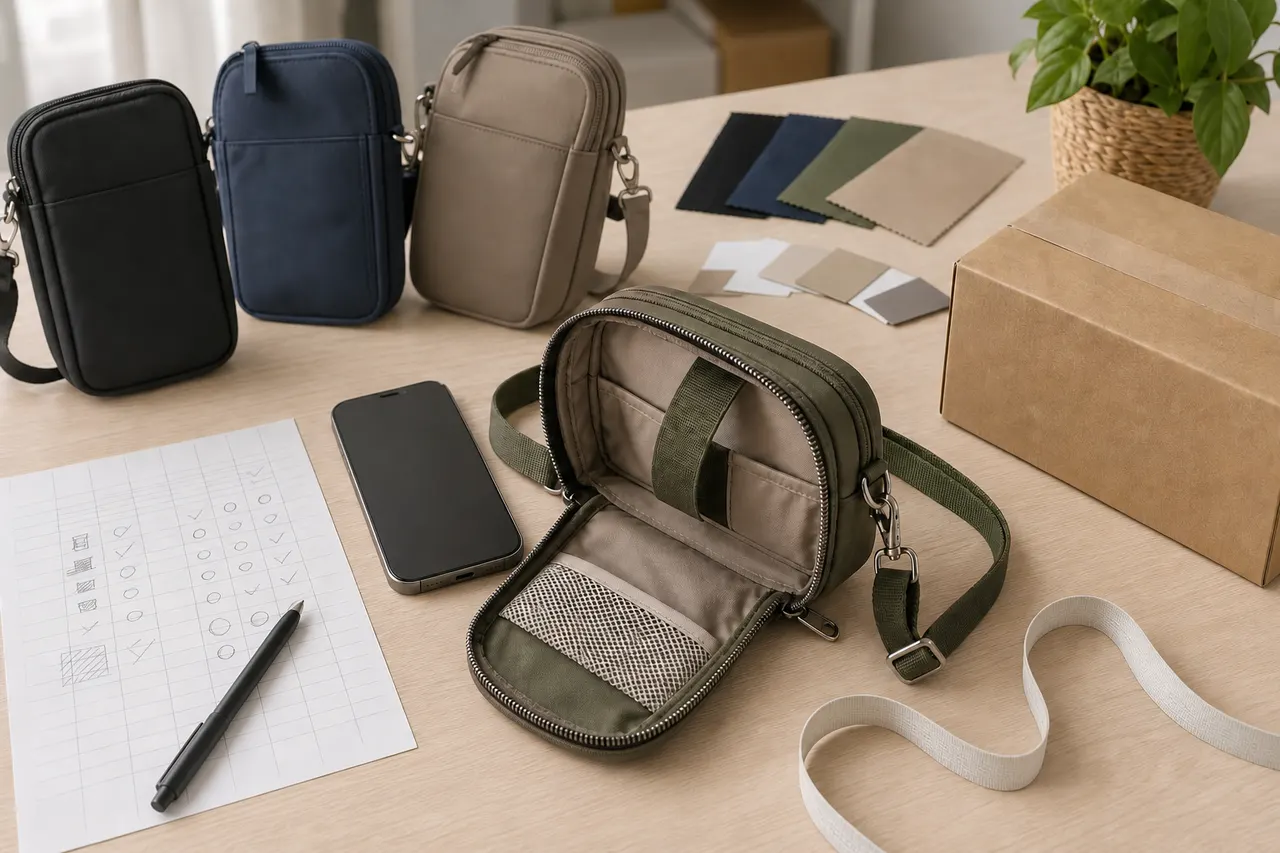
Phone crossbody bags look simple in structure, but what truly affects the experience is not just the appearance. Whether the internal dimensions can accommodate a phone with a case, whether the opening can be operated with one hand, whether the phone might slip out when bending over, and whether the strap attachment points can withstand repeated pulling all need to be confirmed item by item before ordering.
This guide is for buyers who have already found several candidate products in the relevant Spreadsheet on hub-buy.com and want to narrow down the selection to two or three before placing an order. After completing the filtering, you will have a candidate list that includes size rationale, information to be verified, and QC inspection priorities.
If the product page lacks checkable dimensions, structural images, or specification details, the Spreadsheet cannot compensate for these evidence gaps. In that case, you should hold off on ordering rather than guessing based on the name or thumbnail.
Information about link status, inventory, prices, specifications, return/exchange conditions, shipping restrictions, and platform processes in this article is dynamic. Before ordering, refer to the product page, order page, and platform instructions as they appear on August 30, 2026; this article does not provide specific price or policy conclusions without real-time verification.
First clarify what you carry and your usage scenarios
Don't start by picking a bag based on color. First, lay out the items you genuinely need to put in the bag every day, and distinguish between "must carry with you" and "occasionally carry."
Suggested to record:
Phone model, and the actual length, width, and thickness after installing a protective case
Whether you use a lens protector ring, finger ring stand, or card-holder style phone case
Whether you need to also carry a passport, cards, keys, earphones, or charging cable
Main clothing thickness, such as thin summer tops or winter coats
Common actions, such as commuting to swipe cards, traveling to take photos, cycling, or attending events
Whether you often bend over, walk quickly, go up and down stairs, or move through crowds
Use a ruler to measure your phone with the case on; do not simply copy the bare phone dimensions published by the manufacturer. The case bezel, camera bump, and back attachments can all change the actual space occupied. If you also need to carry hard objects like keys, consider whether they might squeeze the screen or scratch the lens.
It is also important to allow reasonable clearance for candidate bags. An interior cavity exactly equal to the phone size does not guarantee smooth access; but too much extra space might cause the phone to wobble while walking. When a product page only provides external dimensions without internal dimensions, mark "usable interior dimensions" as a point to be confirmed. 📏
What the Spreadsheet can help you filter and what it cannot prove
The Spreadsheet is suitable for organizing candidate links and page-visible fields so that different products can be compared under the same set of conditions. It helps you record names, page-stated dimensions, opening types, strap descriptions, and issues to verify, and also allows you to quickly eliminate options that clearly do not meet phone size or scenario requirements.
However, the text and thumbnails in the table alone cannot prove:
The current link is still valid
The product is still in stock and specifications have not changed
The stated dimensions are the usable interior dimensions
Material feel, abrasion resistance, or waterproof ability meets expectations
Zippers, magnetic snaps, and strap buckles are sufficiently durable
Actual color matches the page images
The phone will not slip out of the opening once placed inside
The product is suitable for a particular shipping route
It is recommended to add an "evidence source" and "verification date" for each key field in the table. Content that cannot be confirmed from the current product page should be uniformly written as "to be confirmed," rather than filling in speculation as fact. 🔎
Initial screening by phone size and case thickness
Initial size screening should start with hard elimination criteria. First remove candidates whose page-stated space is clearly smaller than your phone with case, then check the remaining items for opening width, interior photos, or open/closed state images.
You can create the following fields:
Filter Field | Recording Method | Pre-order Judgment |
|---|---|---|
Phone with case dimensions | Measure length, width, thickness | Minimum capacity requirement |
Page-stated dimensions | Distinguish external and internal | Keep doubts if internal not stated |
Effective opening width | Record based on clear statement or verifiable images | Eliminate if smaller than widest phone dimension |
Camera and accessory protrusions | Record protector ring, stand, or card case | Avoid judging by bare phone thickness only |
Additional carried items | List keys, cards, etc. separately | Check if separate compartments needed |
When a page offers multiple size variants, keep the variant name and corresponding dimensions on the same row to prevent selecting the wrong variant when ordering. If size information appears in images, also check the units to avoid confusion between centimeters, millimeters, or inches.
Do not rely solely on descriptions like "fits most phones" or "large capacity" to judge compatibility. Such wording provides no calculable boundary. The most reliable initial screening result comes from actual phone measurements combined with clear product dimension evidence.
Compare opening direction, access workflow, and strap adjustment
The appropriate opening structure depends on which side you usually carry your phone and which hand you prefer to use. Imagine the candidate bag's position as an action route: hand approaches the opening, releases the closure, grabs the phone, takes it out to use, then puts it back and re-closes.
A vertical top opening is generally convenient for pulling the phone out from above, but if the opening lacks a reliable closure, bending over or running may increase the risk of slipping out. A horizontal opening may make it easier to see inside, but the opening length, zipper direction, and body obstruction all affect one-handed access. A flap can cover the opening, but whether the magnetic snap aligns easily and whether the flap hinders quick photo-taking need to be judged from structural images.
Focus on recording the following:
Opening orientation and the starting position of the zipper pull
Whether two hands are required to open and close
Whether the phone gets caught by the flap, zipper edge, or narrow opening when removing
Whether the main compartment has a zipper, snap, magnetic closure, or other anti-drop structure
Whether the strap adjustment range has explicit values
Whether the adjustment buckle might rest on a shoulder pressure point
Whether the strap is attached to the bag body by stitching, riveting, metal rings, or detachable buckles
Whether the left and right attachment points allow adjustment according to your usage habit
"Has a zipper" does not equate to smooth access, and "open top" does not equate to unsafe. The key is whether the closure structure, opening direction, and actual actions together meet the usage scenario. 🎒
Narrow down candidates by commuting, travel, and event scenarios
Commuting scenarios typically require frequent access to your phone, access card, or transit card. Candidates should prioritize one-hand reachability, an opening not blocked by outerwear, and separation of keys from the phone. If you need to squeeze onto public transportation, a structure that stays close to the body and can be fully closed is easier to manage.
Travel scenarios may require carrying a passport, room key, and charging cable. Here, increased capacity is not always an advantage: items concentrated in a single large compartment without dividers might cause cards or documents to be pulled out when retrieving the phone. Also assess whether you can see the opening when the bag is in front of your body, and avoid exposing complete documents or order privacy in public images.
Concerts, exhibitions, and outdoor events often involve longer wear times and more frequent movement. Besides the venue's own bag size restrictions, check whether the strap can be adjusted for different clothing thicknesses, whether buckles are in areas that can be accidentally opened, and whether the opening still has anti-drop protection when bouncing or bending over. Venue rules change, so check the organizer's instructions on the day before attending.
After scenario filtering, keep only one primary use for each candidate. If a bag needs to simultaneously "suit commuting, travel, sports, and formal events" to be justified, it usually means the filtering criteria are still not specific enough.
QC image checklist: stitching, hardware, opening, and strap attachment
QC images help check whether the specific item received at the warehouse has visible issues, but cannot prove long-term durability, actual material composition, or waterproof performance. When viewing images, treat the product page display photos as a specification reference, not as a literal promise of the physical item.
When requesting or viewing QC images, focus on checking:
Front, back, sides, and bottom of the bag for obvious stains, damage, or asymmetry
Whether the opening lies flat when fully open and fully closed
Whether zipper teeth are aligned, and zipper pull and stops show abnormalities
Whether the flap, magnetic snap, or snap button positions are aligned
Whether strap attachment points on both sides have skipped stitches, loose threads, cracks, or obvious misalignment
Whether metal buckles, plastic buckles, and adjustment buckles have missing parts, deformation, or significant scratches
Whether corners and stress points have sufficiently clear close-ups
Whether key dimensions are readable when the ruler is on the same plane as the bag
Whether color judgment is affected by lighting, white balance, or screen display
Front-view photos alone cannot verify strap attachment strength. If key areas are folded, obscured, or out of frame, request additional angles rather than inferring from the appearance of other areas. For dimensions, try to include the measurement start point, end point, and scale markings in the same shot.
If you find problems, first save the corresponding images and order information, then proceed according to the available handling options provided on the order page at that time. Do not assume you can return or exchange, and do not wait until near the deadline to confirm.
Verify links, specifications, returns, and shipping information
Links in the Spreadsheet may become invalid, redirect, or lead to changed product pages. Once you move to the ordering stage, open each final candidate one by one and check that the page title, specification options, and images still match your table records.
It is recommended to review in the following order:
Confirm the link opens the specific product page, not a search page, category page, blank page, or unrelated redirect.
Verify the selected color, size, and style match the candidate in your table.
Record the price, stock status, and seller information shown on the product page that day; do not rely on old screenshots.
Check the return/exchange conditions, handling deadlines, and possible fees visible on the order page.
Confirm whether product material, built-in battery, brand markings, or other attributes might affect available shipping routes.
Before submitting the parcel, follow the routes, billing methods, declaration requirements, and destination country restrictions provided by the platform at that time.
Shipping costs and taxes cannot be judged solely from the bag's product price. The parcel's actual weight, volumetric weight, route restrictions, destination country rules, and declaration information can all affect the final expense. Declare truthfully and do not under-declare, split shipments to avoid taxes, or evade inspection. 🧾
If the product has prominent brand markings, also independently consider intellectual property and shipping restrictions. Inclusion of a link in the Spreadsheet does not guarantee the product's authenticity, legality, or shipping feasibility.
Build the final candidate list and complete the pre-order review
The final list should not keep only one candidate. It is advisable to keep two or three, and for each write down one main advantage, one main risk, and one issue still needing confirmation.
You can record using the following format:
Candidate number and product name
Current valid product page record
Corresponding color, size, and style
Measured phone-with-case dimensions
Page-stated dimensions and evidence location
Opening direction and closure structure
Strap adjustment range and attachment method
Main usage scenario
QC must-check areas
Last verification date for dynamic facts
Unconfirmed information and abandonment conditions
Before ordering, do a reverse check: if phone size evidence is insufficient, key structure cannot be seen clearly, specification names are easily mistaken, or return and shipping conditions have not been confirmed, leave the item in the candidate zone rather than moving directly to purchase.
The savings from this method mainly come from reducing rework caused by size mismatches, specification errors, and obvious QC problems; it cannot promise fixed savings amounts. The added costs are time spent measuring, checking pages, and inspecting images; keeping multiple candidates may also miss short-term inventory, but it reduces the risk of relying on a single uncertain product.
It is more suitable for commuters, travelers, and event participants who value phone fit, frequent access, and anti-drop structures. It is not recommended to force a candidate when size evidence is lacking, product links are abnormal, key QC angles are not visible, or shipping and return conditions cannot be confirmed. The ultimate goal is not to choose the seemingly most popular style, but the one with sufficient evidence, comfortable handling, and acceptable risk. ✅
agent platform shopping FAQ
1. On hub-buy.com, how can I access the quality control images?
When you review the inspection photos on hub-buy.com, pay close attention to the unique characteristics of the item you ordered. For instance, if you bought shoes, check critical parts like toe, heel, and tongue for stitching quality, overall shape, and tongue thickness to determine whether the pair is well made. For garments, examine the collar label, logo embroidery, fabric quality, and how smooth the collar and cuffs are, as well as other specific details.
Browse our latest products and find your next favorite item.